All Hours, All Kwame
Kwame Onwuachi's new cookbook isn't about restaurant food. It's about the food a chef actually wants to eat when nobody's watching.
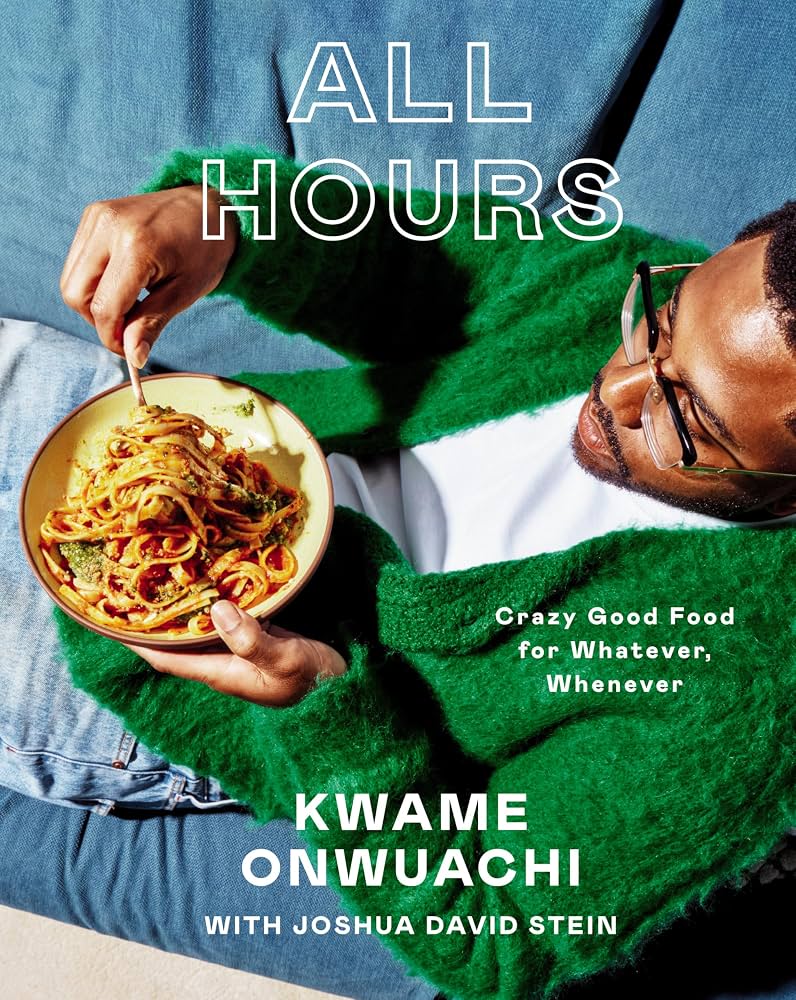
There are chefs who write cookbooks to document their restaurants. There are chefs who write them to teach technique. And then there is Kwame Onwuachi, whose forthcoming All Hours: Crazy Good Food for Whatever, Whenever feels like something more intimate: an invitation into the appetite behind the chef.
Co-written with Joshua David Stein and arriving from Knopf on September 22, 2026, the 288-page book takes the increasingly familiar image of Onwuachi — the award-winning chef, restaurateur, author and cultural figure — and brings the story back to something wonderfully simple.
Delicious food is still what really moves the needle for me.
The answer, apparently, is everything. And at all hours.
It is a small reframing that changes the entire register of the book. A restaurant cookbook asks you to admire. This one asks you to eat.
The chefafter service.
Onwuachi has reached the kind of place in his career where his résumé can almost distract from the food.
He is a James Beard Award winner. He has been recognized by Food & Wine and Esquire, appeared on Top Chef and Chef's Table, and was named to TIME's 100 Most Influential People in 2025. His restaurant empire now stretches across multiple American cities.
But All Hours deliberately turns the camera in another direction. Away from awards. Away from the dining room. Away from the expectation that a celebrated chef must always eat like a celebrated chef.
Instead, we meet the person who still understands the gravitational pull of chicken wings, pork fried rice, a bodega run and the food his mother made.
That distinction matters. Because All Hours isn't simply about what Onwuachi can cook.
It is a book written in the voice a chef uses at the end of a shift, not the voice used at a podium.
Read that way, the recipes stop being a menu and start being a personality.
What Kwameactually eats.
All Hours is structured around how people actually eat rather than around traditional cookbook expectations. Not appetizers, mains and desserts marching in order, but moods, hours and appetites — the food you want when you're hungry, tired, celebrating, hungover or simply curious.
The recipe titles do most of the arguing on their own.
Corn Milk French Toast
Bodega BEC
Souped-Up Top Ramen
Red Stew Chicken Parm
Drunken Noodles alla Vodka
Creole Sausage Roll-Ups
Brussels Sprout Suya
Bougie Chopped Cheese
Tatiana's Cosmic Brownie with Powdered Donut Mousse
The boundaries between “serious” cooking and fun food disappear. New York collides with Nigeria. Louisiana talks to the bodega. Restaurant technique meets late-night appetite. It is precisely the sort of cultural remixing that has made Onwuachi's cooking recognizable.
The pantry isthe cheat code.
If there is a technical thesis in All Hours, it lives in the pantry. Onwuachi's cooking leans on spice blends, marinades and sauces developed across roughly fifteen years of cooking and traveling — the shortcuts that are not shortcuts at all, but stored labour.
A jar of blend built once on a slow afternoon is what turns a weeknight bowl of noodles into something that tastes like it came out of a kitchen with a pass.
The philosophy is refreshingly unprecious about it.
Readers can absolutely use store-bought alternatives, and the book says so. But preparing the foundational blends and sauces yourself brings you considerably closer to the flavours that define his cooking — the seasoning logic underneath the recipes rather than the recipe itself.
Then there'sRiRi's Alfredo.
Every great cookbook needs a story people repeat. All Hours already has one.
During the pandemic, Onwuachi found himself cooking from his friend Rosa Garcia's kitchen in New York, preparing food for hundreds of Bronx residents. One of the dishes he made was Alfredo. Not precious. Not complicated. Comfort food.
Then came a phone call.
Onwuachi was interested — obviously. For the audition, he prepared a version of the Alfredo he'd been making in the Bronx. His trick was blending the sauce to create a lighter, silkier consistency. She loved it.
The dish became RiRi's Alfredo.
A pasta made to feed people in the Bronx becomes the dish served while auditioning to cook for one of the world's biggest stars. Same chef. Same instinct. Different room.

That is the whole book in one anecdote: the food does not change class when the room does.
Food doesn'thave office hours.
Traditional cookbooks are organized around breakfast, lunch and dinner. Real life — especially hospitality life — doesn't always work that way.
Dinner might happen at midnight. Breakfast might happen at noon. A restaurant chef can feed hundreds of people before finally asking the only question left: what am I going to eat? All Hours embraces that reality — late-night food, recovery food, pre-service food, days off and whatever tastes good in the moment.
The bigger storyis Kwame.
Onwuachi's career rejects the idea that a chef must be one thing.
Chef.
Restaurateur.
Author.
Television personality.
Entrepreneur.
Cultural storyteller.
His food vocabulary comes from three places at once: New York, Nigeria and Louisiana. The bodega and the pot of stew and the roux are not separate influences to be kept in their lanes; they are the same sentence.
Those places aren't merely biography. They became vocabulary.
The books.
Seen against the two books that came before it, All Hours reads like the third movement of an argument.
Notes From a Young Black Chef
My America
All Hours
Once you've told people where you came from and what shaped you, perhaps the next form of freedom is simply showing them what gives you pleasure. No explanation required. Just eat.
Food is neverjust food.
At FRESH, we're interested in the moment when food becomes bigger than food. All Hours arrives in that territory.
It reflects a generation of cooks who don't see contradictions between fine dining and the bodega, between heritage and experimentation, between a celebrated restaurant dish and something eaten standing over the kitchen counter at 2 a.m.
That's culture. And that's what makes this release worth watching.
After all the accolades, restaurants, television appearances and impossible reservations, Kwame Onwuachi still sounds fascinated by the same thing that starts almost every great culinary career:
Something delicious.Whenever.Wherever.At all hours.
FRESH /Culture.
Food • Books • People • Ideas — this isn't a cookbook review. It's a culture story about a chef, an appetite, and the way we actually eat.